I Thought 2025 Was Cloudy. 26 Years of Data Proved Me Wrong

I Thought 2025 Was Cloudy. 26 Years of Data Proved Me Wrong
It was a gloomy December day of 2025 when the thought hit me: “I feel like 2025 was cloudier than usual. I barely saw the sun all year.”
The feeling was so strong that I decided to prove it. I downloaded 26 years of hourly cloud cover data for Wrocław, Poland—227,928 measurements spanning from 2000 to 2025.
Spoiler: The data had other plans.
What the Numbers Said
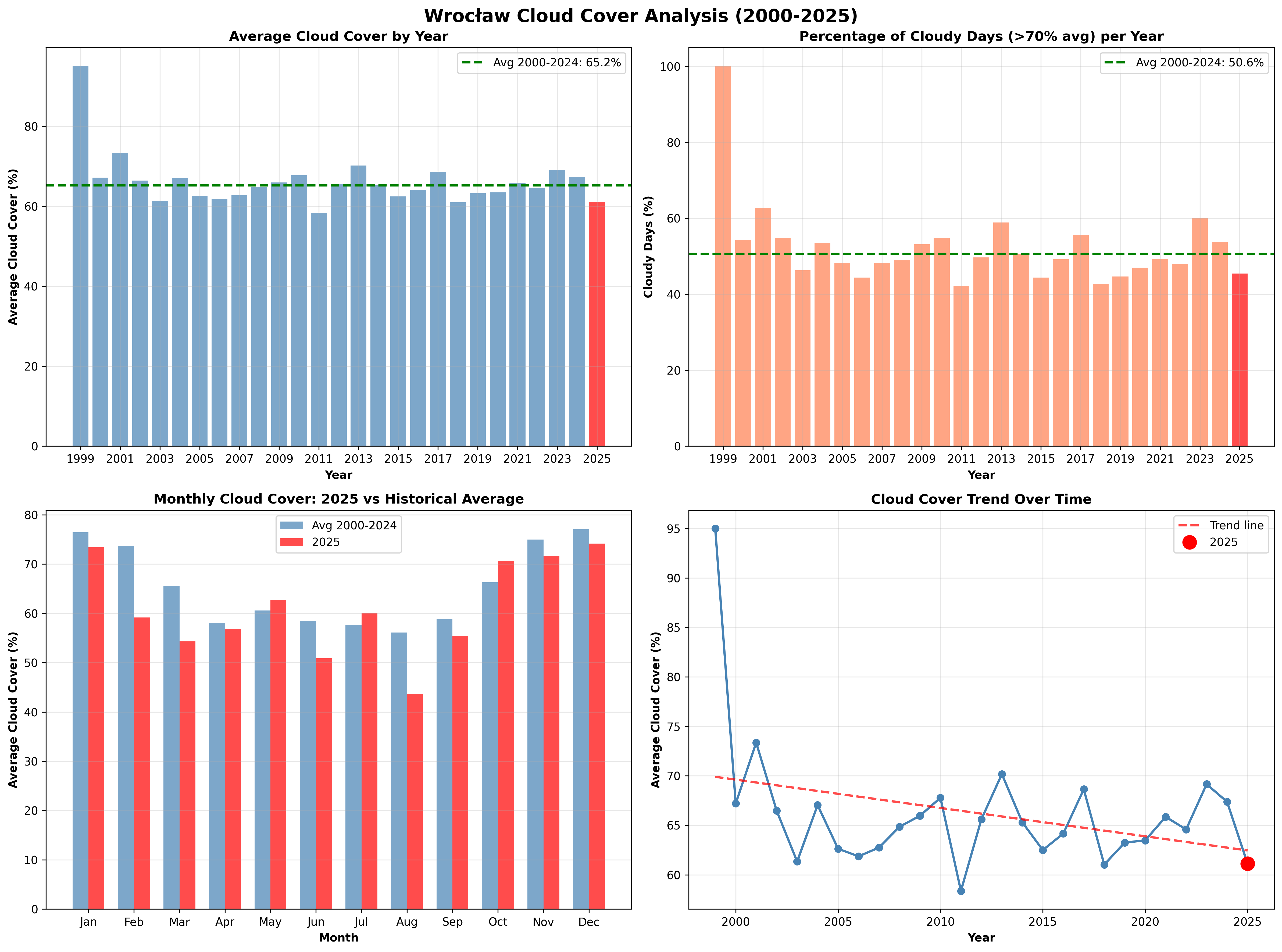
When I ran the analysis, my jaw dropped. The year I was certain was exceptionally cloudy turned out to be one of the sunniest on record:
- Average cloud cover: 61.1% (vs. historical average of 65.2%)
- Clear sky hours: 33.0% (vs. historical average of 24.7%)
- Ranking: #25 out of 27 years in cloudiness
Only 2 years since 2000 were sunnier than 2025.
Let that sink in. The year I was absolutely certain was gloomy was actually one of the brightest in over two decades.
Why My Brain Lied to Me
The answer came from the monthly breakdown. October 2025 was indeed cloudier than usual—about 4.3% above average. Since I formed my opinion in late December, those recent cloudy autumn days dominated my memory of the entire year.
Meanwhile, August 2025 was spectacularly sunny with only 43.7% cloud cover (compared to the historical average of 56.1%). But I’d already forgotten about it.
That’s recency bias in action. Recent experiences weigh disproportionately heavy in our memory, drowning out everything that came before.
The Broader Lesson
Our feelings are terrible statisticians.
How often do we confidently assert things like:
- “Traffic is getting worse every year”
- “Winters aren’t as cold as when I was a kid”
- “This restaurant’s quality has declined”
Without data, we’re just trusting our flawed, biased brains to accurately aggregate hundreds of experiences over months or years. We’re not built for that.
We’re systematically biased by:
- Recent experiences (recency bias)
- Memorable dramatic events (availability heuristic)
- Negative experiences (negativity bias)
- Our current emotional state (mood-congruent memory)
The Bottom Line
Yes, I miss the sun. But 2025 gave me plenty of it—I was just looking the other way.
Next time you catch yourself thinking “this year was unusually [something],” challenge yourself to gather data. You might be surprised by what you find.
So here’s my question: What perception are you holding onto without evidence? What feeling seems so obviously true that you haven’t bothered to check?
The data might surprise you.
Discussion: This post is being discussed on Hacker News.
Further Reading
If you’re fascinated by how our minds deceive us, these books dive deep into cognitive biases:
- “Thinking, Fast and Slow” by Daniel Kahneman - The classic exploration of how our two thinking systems lead us astray
- “Misbelief” by Dan Ariely - A fresh look at why we believe things that aren’t true and how misinformation spreads
Want to check your own weather perceptions? Download the data fetching script and analysis script to replicate this for any city using the free Open-Meteo Historical Weather API.
Thanks for reading! If you'd like to share your thoughts send me an email.