I Stopped Using Stack Overflow. So Did Everyone Else.
I Stopped Using Stack Overflow. So Did Everyone Else.
I stopped using Stack Overflow. I recently noticed this. Before that, it was my primary point of contact. When I had a question about developing, and Google returned Stack Overflow in the results, I automatically headed there.
And then I stopped. I don’t know when exactly. Probably when I discovered AI could answer my questions and the quality was at least good enough.
Was I the only one? I decided to check that.
Here’s what I found.
The Data Tells a Story
I queried the Stack Overflow API for every month from August 2008 to December 2025. That’s 18 years of data, covering the entire history of Stack Overflow.
The numbers tell a dramatic story.
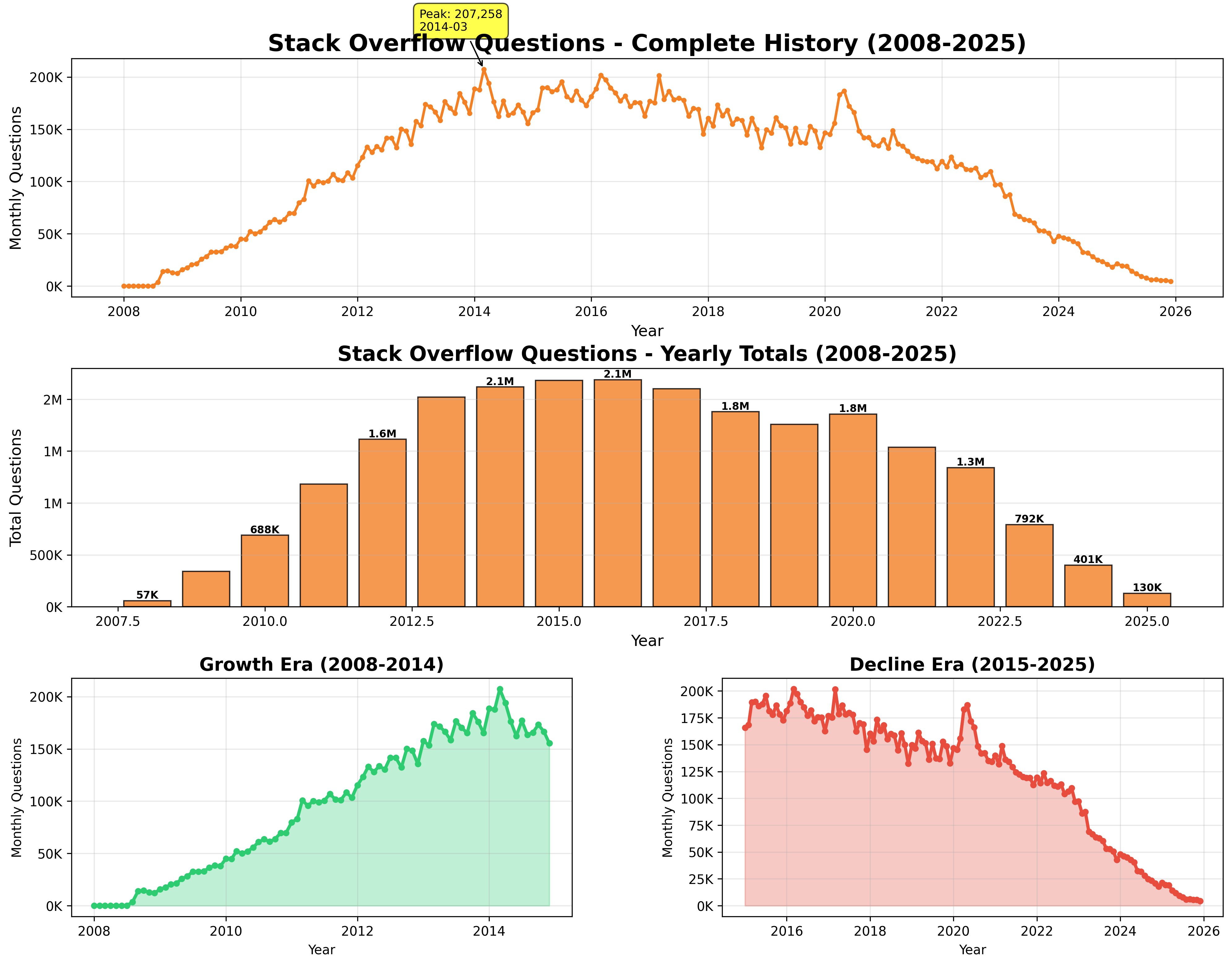
Peak (March 2014): 207,258 questions per month December 2025: 4,470 questions per month
That’s a 98% decline from the peak. But the decline didn’t start immediately. Stack Overflow grew exponentially from 2008 until it peaked in 2016 at 2.1 million questions per year. Then it started declining.
Here’s the complete history:
The Growth Years (2008-2016):
- 2008: 57,159 questions (4 months of operation)
- 2009: 340,305 questions (+495%)
- 2010: 688,587 questions (+102%)
- 2011: 1,180,358 questions (+71%)
- 2012: 1,613,093 questions (+37%)
- 2013: 2,018,896 questions (+25%)
- 2014: 2,117,461 questions (+5%)
- 2015: 2,179,745 questions (+3%)
- 2016: 2,187,227 questions (+0.3%) ← Peak year
The Plateau and Early Decline (2017-2022):
- 2017: 2,101,316 questions (-3.9%)
- 2018: 1,878,739 questions (-10.6%)
- 2019: 1,756,920 questions (-6.5%)
- 2020: 1,856,838 questions (+5.7%)
- 2021: 1,536,518 questions (-17.2%)
- 2022: 1,340,557 questions (-12.8%)
The Collapse (2023-2025):
- 2023: 792,293 questions (-40.9%)
- 2024: 401,603 questions (-49.3%)
- 2025: 130,099 questions (-67.6%)
When It Changed
Look at those year-over-year changes. Notice anything?
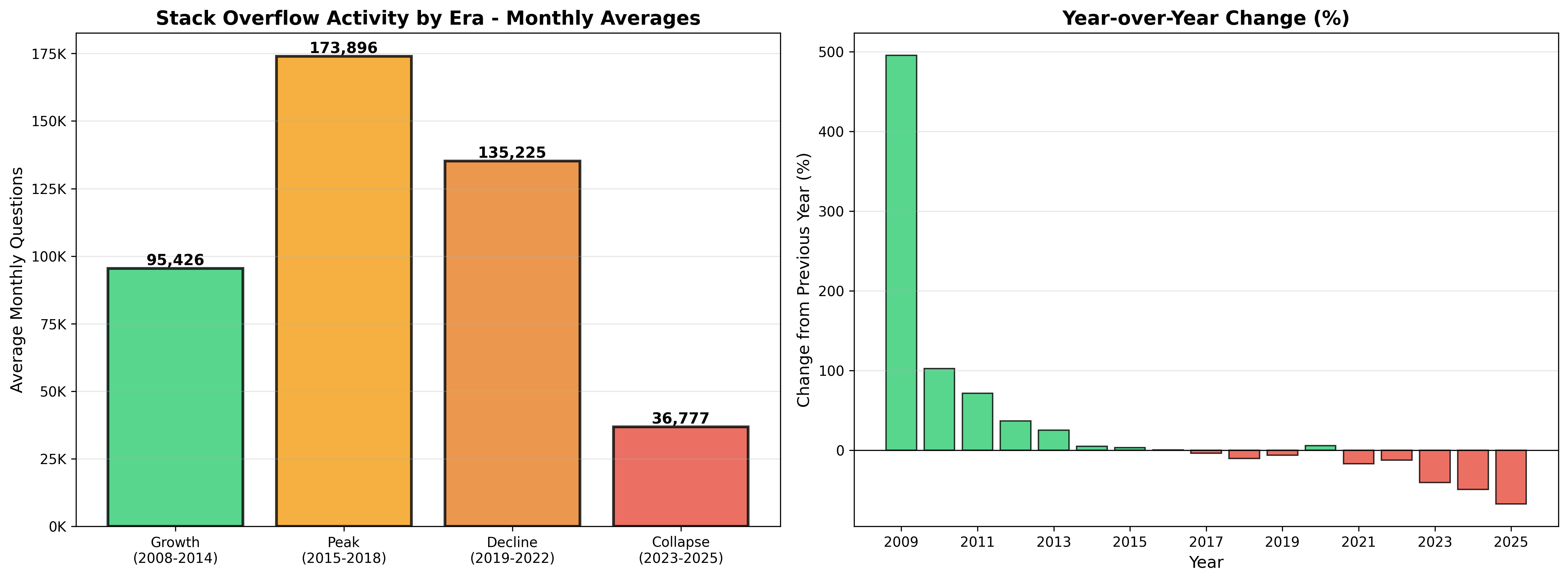
From 2009 to 2013, Stack Overflow grew by double digits every single year. Sometimes triple digits. It was unstoppable.
Then growth slowed. By 2017, it started declining modestly. 2020 even saw a brief uptick (+5.7%), possibly from pandemic-driven coding activity.
But 2020 to 2021: -17% decline. 2021 to 2022: -13% decline. People were still asking questions, just fewer.
Then 2023 hits. A 40.9% drop in a single year. Followed by 49.3% in 2024. Then 67.6% in 2025.
What happened in late 2022 that would cause this? ChatGPT launched on November 30, 2022.
The timing isn’t a coincidence.
Looking at the full 18-year history, you can see four distinct eras:
- Growth Era (2008-2014): Average of 95,426 questions/month
- Peak Era (2015-2018): Average of 173,896 questions/month
- Decline Era (2019-2022): Average of 135,225 questions/month
- Collapse Era (2023-2025): Average of 36,777 questions/month
The most dramatic shift happened between the Decline and Collapse eras. Right when AI assistants became widely available.
What This Actually Means
Stack Overflow didn’t become worse. The questions didn’t disappear because developers stopped coding. They disappeared because developers stopped needing to ask them publicly.
When I hit a coding problem now, I don’t:
- Search Google
- Click through to Stack Overflow
- Read five different answers
- Try them all until one works
I just ask Claude or ChatGPT. I get an answer immediately. It’s specific to my exact problem. It explains why it works. And I can ask follow-up questions.
Why would I go back to Stack Overflow?
The Methodology Question
Before you ask: yes, I validated this data. I analyzed 24.1 million questions across 216 months (August 2008 - December 2025). I checked the API responses, tested multiple endpoints, and documented every limitation of this approach.
The Stack Overflow API’s total field might not be perfectly accurate. It could be off by thousands. But it can’t be off by millions. The trend is real.
If you want the full methodology breakdown with all the caveats about deleted questions, timezone handling, API limitations, and validation queries you can run yourself, I documented everything here.
What about you? When’s the last time you asked a question on Stack Overflow? And if you stopped—did you notice when?
Data & Methodology
This analysis is based on 24,177,714 questions collected via the Stack Exchange API v2.3, covering 216 months from August 2008 through December 2025.
Key Findings:
- Peak month: March 2014 (207,258 questions)
- Peak year: 2016 (2,187,227 questions)
- Decline from peak to December 2025: 98%
- Most dramatic drop: 2023 (-40.9% year-over-year)
For complete methodology, data validation queries, limitations, and reproducibility details, see the full methodology document.
Thanks for reading! If you'd like to share your thoughts send me an email.