Check That Cheaper One

Check That Cheaper One
More from You Can Do Better — small product decisions that cancel out what the product is trying to do.
I was about to buy a keyboard. I asked Claude to check the offer first.
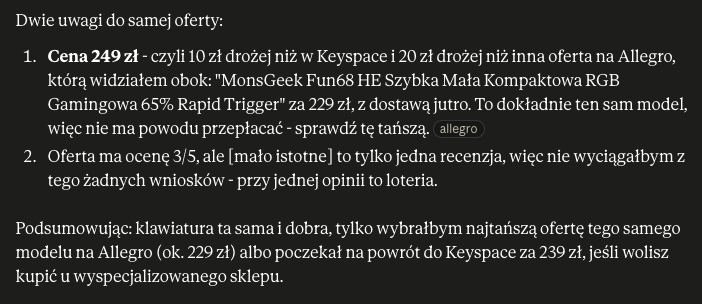
It caught two things I hadn’t. The price is 20 zł above the same model sold elsewhere on the same site. And the 3-out-of-5 rating comes from one review, which means nothing.
Good answer. I saved money.
Then I read the last line again: “sprawdź tę tańszą” — check that cheaper one.
It only looked where it was standing
Every price came from the page I gave it. Another listing on the same site. A shop that listing mentioned. It found the lowest number in that set and called it the cheapest.
That’s the cheapest here.
The keyboard is a standard model with a name, and a dozen other shops sell it. None of them were in the answer, because none of them were on the page. So “buy this one for 229 zł” rests on a sample of three, picked by whoever built the page I happened to open.
The second half of the job
The first half is reading the page. It did that well.
The second half is leaving it: take the model name, search the open web, come back with prices from shops the listing has no reason to mention.
Instead I got the to-do. And I did it — opened the listings, compared prices, checked delivery. Ten minutes of the work the answer had just proven was necessary.
What to do instead
- Treat the page as a starting point, not the market. One site’s cheapest offer isn’t the cheapest offer.
- Search on the identifier. Model name, ISBN, part number — that’s the key to every other shop.
- Finish the thought. If you name a next action and can take it, take it, then report what you found.
- Come back with numbers. Three shops with prices and delivery dates beats “you can probably find it cheaper”.
It found the cheapest one on the page. I needed the cheapest one.
You can do better.
Thanks for reading! If you'd like to share your thoughts send me an email.